The selection of a growing medium for commercial horticulture is not a matter of picking a product by name or fibre content. The physical structure of the medium directly affects water-holding capacity, aeration and drainage, the number of irrigations required, and the environment of the rootzone.
For coco coir crops, the most suitable structure will relate to the crop, container or grow-bag size, the environment, the watering strategy, and the length of the growing cycle. According to data released by Horti Daily, not all coco blends are suitable for all growing systems; the structure of the substrate must be appropriate for the production.
As the media dries, it takes in a mix of water and air-filled pores. The size and pore configuration of these voids will dictate the rate of movement of water and how much residual oxygen is left at the root zone.
A substrate with very small particles can hold a lot of moisture but may have little room for air if it packs down. Material with more coarse particles can allow for greater drainage and airflow but may also dry out faster.
The aim therefore is not to optimise either water holding capacity or water drainage. The intention is to achieve a consistent balance that is appropriate for the crop and the irrigation programme.
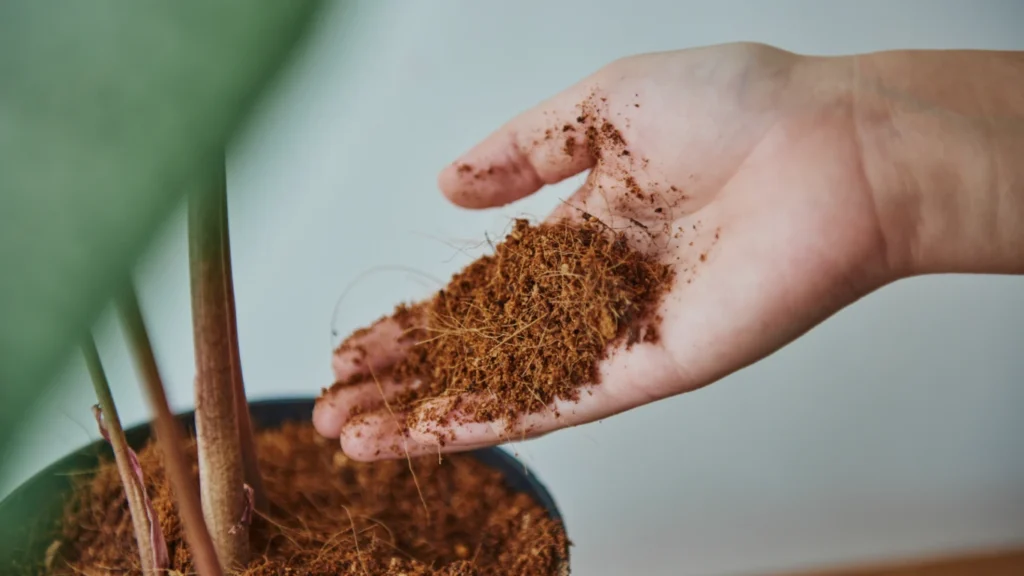
It’s possible to make coco coir with various ratios of pith, chips and fibre. Finer parts tend to add to the water-holding capacity, but the inclusion of larger chips increases macroporosity and leaves more room for air and drainage.
This therefore makes the substrate composition an important decision for growers.
A crop with a moisture-demanding root zone would prefer a structure with a greater percentage of fine coir. Crops or production systems which require greater drainage may want a coarser structure containing a greater quantity of chips.
The balance for early watering with minimal water applied is also a factor of the number of irrigations given, the volume per irrigation, the age of the root system, the greenhouse environment and the rate of dry-back.
Different farms or crops may not respond to the same substrate specification. Climate, greenhouse, crop duration, irrigation equipment and container volume can all play a role in substrate response.
For instance, a coarser structure that irrigates too often may have dry down too fast if irrigated less frequently; a moister-holding structure will stay moist longer if irrigated less frequently.
Growers have the option of testing the new substrate on a small scale, for example through representative hydration trials and crop trials. Growers can then get a feel for expansion, drainage, moisture retention and behaviour in the root zone in practice.
The particle size is one of the most significant factors affecting the structure of a substrate. Smaller coir particles form smaller pores which retain water, whilst larger chips and fibres form large pores which promote airflow.
A more evenly balanced mix will therefore allow a little moisture to remain and access to oxygen.
But too much fine material or compaction limits available air space and can cause uneven wetting. Alternatively, the structure can be too coarse and too free-draining for a specific irrigation programme.
Here is an example of how understanding these differences will help growers select a substrate based on root-zone requirements rather than simply using whatever everyone else is using.
Coco coir can be compressed into blocks or slabs for shipping and storage. But the dimensions of a compressed block or slab don’t always translate to the final product once it’s been wetted.
When expanded, a quality media should recover uniformly. Too much or uneven pressure can influence the pore space, expansion volume, and water absorption.
The bottom line for the grower is that after applying a standard hydration procedure, the size and structure of the hydrated material need to be checked and found to be uniform. Under the same hydration regime, the results seen by different substrates are much more revealing as to how they will perform in the production system.

Mathew is a product designer and engineer at Coirmedia, where he combines his passion for sustainability with his design and engineering expertise. He develops innovative coir products that are not only functional but also eco-friendly. Driven by a desire to share his knowledge, Neil is passionate about writing and teaching, aiming to educate others about his ideas, innovations, and the technology behind them.