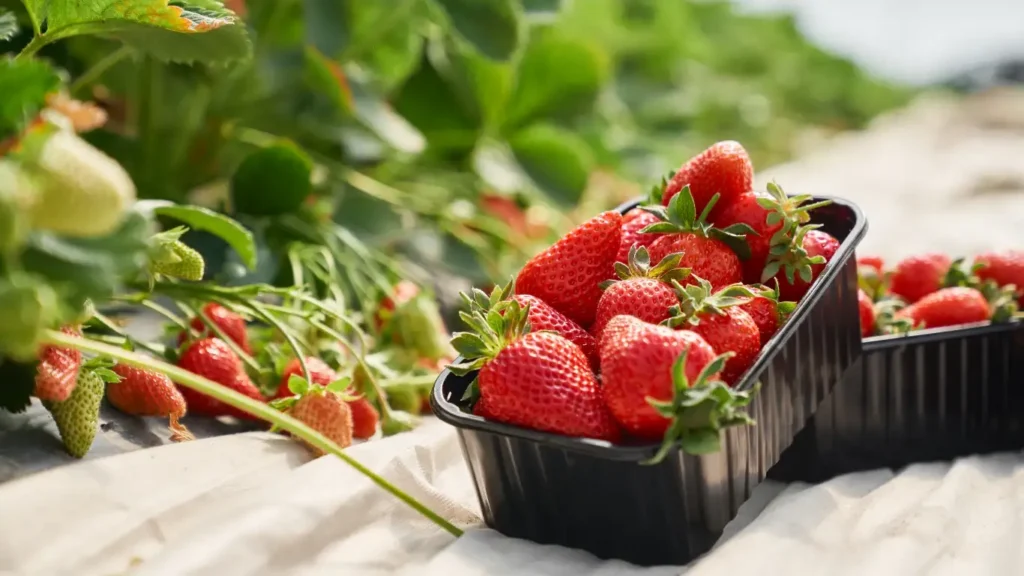
Greenhouse strawberries allow growers to have more control over the plant environment where flowers and fruit develop. Without having to depend completely on outdoor weather conditions, cultivators can regulate temperature, humidity, irrigation, light and root-zone conditions.
They require certain conditions to grow, and if these are not met to the correct levels the strawberries will not grow to their best potential. The key to this is temperature and moisture and these are critical as they affect the strawberry plant, growth, nutrients, fruit, disease problems.
Temperature needs will vary between the early, middle, and final stages of the strawberry season. As explained in the greenhouse growing guidance, temperatures may be as low as 8C overnight and 16C during the day early on in the season, then increase as the plants grow.
Approximately 20C to 24C during the day and 10C to 12C at night are good all-round minimum average temperature targets as the crop develops. Around 16C to 20C is best during flowering, and even cooler for ripening the fruit.
It’s equally vital to stay at or near the target temperature. Too high or low a temperature can disrupt plant growth and fruiting. Systems for greenhouse heating, ventilation, shading, and cooling all allow growers to adapt to conditions outside the ideal temperature.
Humidity levels play an essential role in greenhouse strawberries production also. As indicated in the reference, relative humidity around 60% to 75% is appropriate for strawberry cultivation, and VPD levels will then change depending on temperature.
Humid conditions contribute to moisture loss in plants and have an impact on transpiration. Too much humidity also exposes plants to the Botrytis and powdery mildew pathogens. Too dry conditions stress plants due to water loss, which may also affect fruit quality.
The goal should thus be to keep humidity at a consistent level rather than trying to eliminate it completely.
Since strawberry plants transpire all the time, they continuously emit water vapor. Water vapor rapidly accumulates in a closed greenhouse, especially if there are many plants.
Condensation can build up on plant and greenhouse surfaces when humidity is high. Long-term moisture can lead to an environment conducive to fungal pathogens.
Humidity will also affect the passage of nutrients and water through the plant. The connection for some nutrients and water through the plant relies on transpiration, so high humidity can make this more difficult.
Don’t treat temperature and humidity as isolated factors. Increasing the temperature of the greenhouse also shifts the relationship between air temperature and humidity.
Growers may find it more valuable to be able to keep an eye on relative humidity and VPD instead of only the humidity. VPD, in fact, adds a measurement of temperature in addition to the moisture content in the air.
A stable climate helps to prevent some of these abrupt changes which can add unnecessary strain to a plant. Greenhouse systems should be based on ongoing measurement and incremental change.
Well-ventilated air can go a long way in even heat and moisture distribution throughout your greenhouse. Poor airflow can result in pockets of humidity where heavy foliage will be poorly developed.
Ventilation can be effective in eliminating excess moisture when the outside conditions are appropriate, but it can also vent heat and other managed inputs from the greenhouse. If the weather is cold, rainy, or very humid, opening vents alone may not be sufficient to control the humidity.
Hence the reason why some commercial growers integrate ventilation with dedicated climate-control and dehumidification solutions.
Managing the air in your greenhouse is just one part of growing healthy strawberries. You will also want to tend the root-zone environment.
Strawberries have shallow roots and prefer a moist root environment that does not become overly saturated and drain excess water well. Too much moisture (wet) can affect the roots, and too little will stress the plants.
Coco coir is being used to relatively equalize water retention and aeration when producing strawberries soilless. Various particle sizes are blended together to alter physical characteristics based on climate, irrigation frequency, and production goals.
You also have the possibility of using strawberry grow bags directly for protected and soilless cultivation in order to better control the root zone and facilitate the control of irrigation/fertigation.
The volume of substrate, shape and drainage properties of the bag can affect the rate of root zone drying, as well as the removal of excess water. Grow bags can be located at comfortable height levels, which can make crop harvesting or processing easier.
Grow bags, together with a well-chosen coir substrate, can be combined to complement other components in an integrated plant care system, including moisture, aeration and nutrition.
However not all coir merchandise have the same properties. The particle measurement, water-retaining properties, aeration, drainage, pH and electrical conductivity of each coir product differ.
Thus, commercial strawberry growers should carefully choose the substrate based on their greenhouse climate and irrigation practices. Finer material may hold more water, with larger coir fractions providing more air space and better drainage.
Bagging a Commercial Crop Consistency is especially important in a commercial crop because this difference in a batch can influence the irrigation and fertigation.
A knowledgeable coir products manufacturer can guide growers in choosing products that will reliably perform in their system.
Achieving a high-yield greenhouse strawberry crop involves managing the growing environment as a whole. There is more to greenhouse strawberry production than controlling temperature. All aspects of the greenhouse environment, such as humidity, VPD, air movement, temperature, irrigation, fertigation, and root-zone conditions, affect each other.
Aim to maintain a daytime temperature of about 20C to 24C, a nighttime temperature of about 10C to 12C and a relative humidity of about 60 to 75%. These are rough guidelines and will vary depending on the particular variety, crop stage, and glasshouse conditions.
With good climate control and the right growing media and design for the strawberry grow bags can create a more predictable environment for healthy plant growth and fruit.
What you would want to find in the perfect strawberry greenhouse is one where the environment is constantly observed and manipulated during the crop cycle. Temperature and humidity are only part of that equation, combined with airflow, irrigation, nutrition, and the root zone.
While it can be beneficial to integrate controlled greenhouse production with other types of strawberry production, coco coir can give growers a versatile, water-retentive, aerated medium that can help strawberries thrive. With the appropriate substrate and a well-designed grow bag with an ideal climate, growers can look forward to uniform fruiting.

Mathew is a product designer and engineer at Coirmedia, where he combines his passion for sustainability with his design and engineering expertise. He develops innovative coir products that are not only functional but also eco-friendly. Driven by a desire to share his knowledge, Neil is passionate about writing and teaching, aiming to educate others about his ideas, innovations, and the technology behind them.